
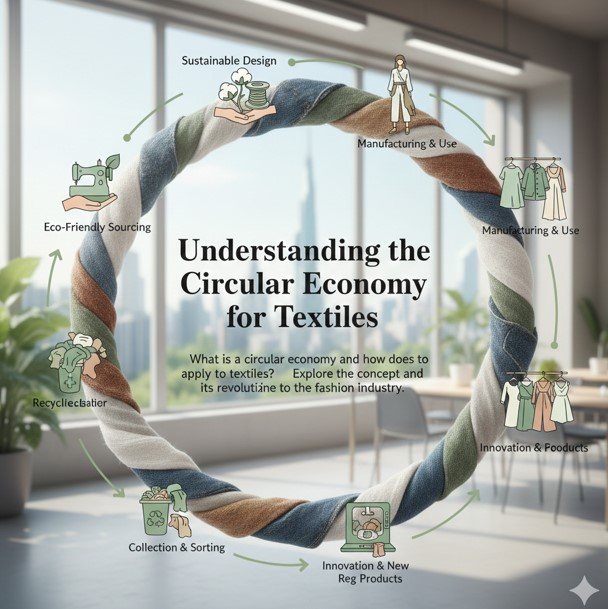
The traditional path of a T-shirt is a straight line: we extract raw materials, manufacture the garment, wear it a few times, and then toss it away. This is the Linear Economy—often summarized as “Take-Make-Waste.”
In contrast, the Circular Economy aims to bend that line into a circle. It’s a systemic approach designed to eliminate waste and keep materials in use for as long as possible. In the world of fashion, this isn’t just a trend; it’s a necessary revolution.
The Three Pillars of Circularity
To understand how a circular textile industry works, we look at three core principles defined by the Ellen MacArthur Foundation:
- Design Out Waste and Pollution: 80% of a product’s environmental impact is determined at the design stage. This means choosing non-toxic dyes and monomaterials (like 100% cotton) that are easier to recycle than complex blends.
- Keep Products and Materials in Use: Through repair, resale, and rental, we ensure a garment lives many lives before it is ever considered “waste.”
- Regenerate Natural Systems: Instead of just “doing less harm,” circular fashion seeks to do good—using regenerative farming for cotton or wool that actually restores soil health.
How it Works: The Technical vs. Biological Cycle
The circular economy splits materials into two distinct “loops”:
The Biological Loop
This involves natural fibers like cotton, silk, hemp, and wool. In a circular system, these garments are designed to be biodegradable. Once they are truly worn out, they can be composted, returning nutrients to the soil to grow the next crop of fibers.
The Technical Loop
This involves synthetic fibers like polyester and nylon (which are essentially plastic). Since these don’t break down, the goal is to keep them in a closed loop.
- Mechanical Recycling: Shredding fabric to make insulation or rags.
- Chemical Recycling: Breaking down polymers to their molecular level to create “virgin-quality” yarn over and over again without losing strength.
Why the Fashion Industry Needs This
The statistics for the current linear model are staggering:
- The Waste: Every second, the equivalent of one garbage truck of textiles is landfilled or burned.
- The Cost: Underutilized clothes and lack of recycling cost the global economy roughly $500 billion every year.
- The Carbon: The textile industry is responsible for about 10% of global carbon emissions—more than all international flights and maritime shipping combined.
Success Stories: Circularity in Action
| Strategy | Example | How it Works |
| Resale/Re-commerce | Patagonia Worn Wear | The brand buys back used gear, repairs it, and resells it at a lower price point. |
| Rental Models | Rent the Runway | Instead of buying a dress for one gala, multiple users share the same high-quality garment. |
| Fiber-to-Fiber | Circulose® | A new technology that turns discarded cotton textiles into a dissolving pulp used to make fresh viscose or lyocell. |
The Path Forward: What Can You Do?
While brands need to change their infrastructure, consumers act as the “engine” of the circular economy. You can participate by:
- Prioritizing Quality: Buying clothes built to last so they can be resold or passed down.
- Checking Labels: Looking for monomaterials (100% of one fiber) to ensure future recyclability.
- Demanding Transparency: Supporting brands that offer “take-back” schemes for their old products.
The circular economy transforms fashion from a consumption-based industry into a service-based one, where the “wonder” of a garment isn’t just in its first wear, but in its infinite potential.